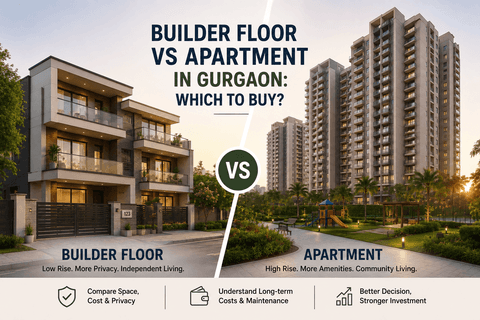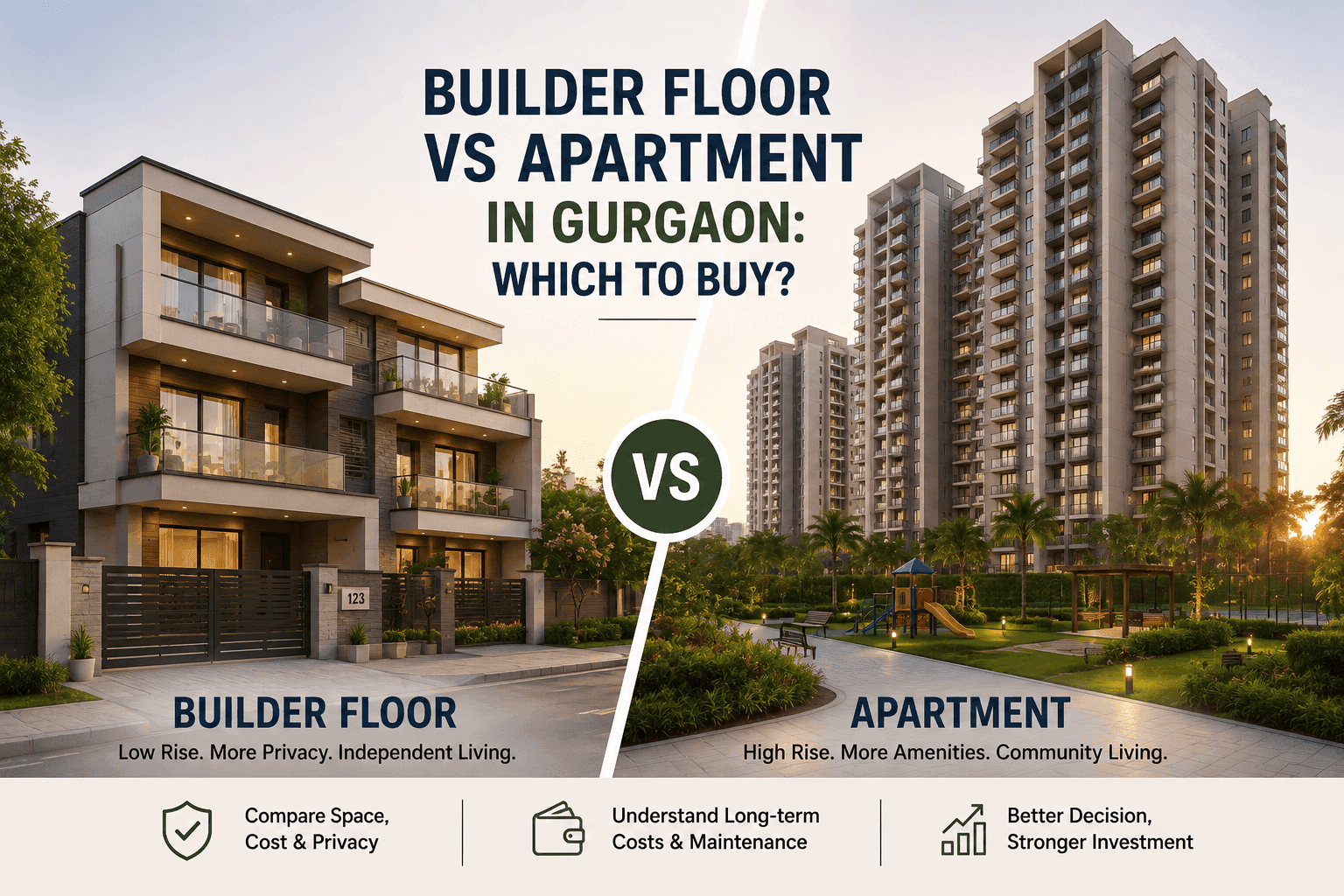
Builder Floor vs Apartment in Gurgaon: Which Should You Buy?
Real Better Team
August 3, 2026
Comparing builder floors and apartments in Gurgaon on space, cost, privacy and resale — a practical breakdown to help you decide.
If you've spent any time house-hunting in Gurgaon, you've run into this decision: builder floor or apartment. Both are widely available across the city's major residential corridors — Golf Course Road, Golf Course Extension Road, Sohna Road, Dwarka Expressway — and both can be excellent homes. But they're genuinely different products, and the right choice depends less on which one is "better" in the abstract and more on what you personally prioritize.
This guide breaks down the real differences — not just in price, but in day-to-day living, long-term costs, resale dynamics, and financing — so you can make the comparison against your own priorities rather than someone else's.
What's the Actual Difference?
A builder floor is one floor of a low-rise building — typically three to four floors total — where each floor is sold and registered independently. You own your specific floor outright, with your own registry, rather than owning a unit within a larger collectively-managed building.
An apartment is a unit within a larger multi-tower or multi-block society, typically managed by a Residents' Welfare Association (RWA) or a professional facility management company. Apartments share common infrastructure — lifts, security, parking structures, and usually a broader set of amenities — across potentially hundreds or thousands of units.
The distinction sounds simple, but it cascades into almost every other difference between the two — density, amenities, cost structure, privacy, and even how the resale market treats each type.
Density and Privacy
This is often the starting point for buyers who lean toward one option or the other.
A builder floor building typically has just a handful of units total — often one unit per floor, sometimes two. You're sharing a building with a small number of neighbors, and depending on the specific building's design, you may have limited or no shared common areas beyond a stairwell or small lobby.
An apartment society, by contrast, can range from a few dozen units to several thousand across multiple towers. You'll share lifts, lobbies, parking, and amenity spaces with a much larger number of households.
For buyers who value privacy, quiet, and minimal shared-space interaction, this is usually the single biggest factor pulling them toward a builder floor. For buyers who want a built-in sense of community, more security through higher occupancy and staffing, and don't mind sharing common spaces, an apartment society often feels more comfortable.
Amenities
This is where apartments generally have a structural advantage, simply because of scale. Larger societies can support amenities that wouldn't be economically viable for a four-unit building — a full clubhouse, swimming pool, dedicated children's play areas, jogging tracks, multi-purpose halls, and often 24/7 professional security staffing.
Builder floors typically offer minimal to no shared amenities. Some newer builder floor developments — particularly in areas like Golf Course Extension Road — have started bundling in small shared amenities (a common terrace, basic security) to compete more directly with apartment societies, but this varies significantly by project and shouldn't be assumed without checking the specific listing.
If amenities are a genuine priority — especially for families with young children who'll use a play area regularly, or anyone who values having a gym or pool on-site — this is a meaningful point in favor of an apartment.
Maintenance Costs
Apartment societies typically charge monthly or quarterly maintenance fees that fund the amenities, staffing, and common area upkeep described above. These charges scale with the amenities on offer — a society with a large clubhouse and extensive landscaping will generally have higher maintenance charges than a more modest one.
Builder floors, with minimal shared infrastructure, typically have lower ongoing maintenance costs, sometimes limited to basic stairwell/common area upkeep split between the handful of units in the building.
Over a long holding period, this difference compounds. It's worth asking for the actual current maintenance figure — not an estimate — for any specific apartment society you're considering, since this varies significantly between projects and isn't something to assume based on general expectations.
Carpet Area for the Price
This is one of the more consistent patterns buyers report when comparing the two options directly: builder floors often deliver more carpet area for a comparable price point than apartments in the same micro-market. This makes intuitive sense — apartment pricing effectively bundles in a share of the shared amenities and common infrastructure, while a builder floor's price is more directly tied to the private space itself.
This isn't a universal rule — it varies by specific project, builder, and micro-market — but it's a pattern worth specifically checking when comparing two options that otherwise seem similar in price. Ask for exact carpet area figures (not just super built-up area, which can be misleading) for both options before comparing on a per-square-foot basis.
Parking
Parking arrangements differ meaningfully between the two. Apartment societies typically offer structured, allocated parking — often basement or podium parking with assigned or first-come reserved spots, managed as part of the overall society infrastructure.
Builder floors often have more limited parking, sometimes just one or two open spots per unit, without the structured multi-level parking that larger societies can build. If you own multiple vehicles or frequently have guests, this is worth checking specifically for any builder floor you're considering, since it varies significantly by building and isn't standardized the way apartment society parking tends to be.
Resale Liquidity
This is a genuinely important, and sometimes underestimated, factor — how easily can you sell the property later if your circumstances change?
Apartments in established societies generally see more consistent resale demand. This comes down to a few factors: a larger addressable pool of buyers who are specifically looking for apartment-style living, more standardized comparables (it's easier for a buyer or bank to assess "fair value" for an apartment when dozens of similar units in the same society have sold recently), and generally easier financing for buyers, which widens your pool of potential purchasers.
Builder floors can see more variable resale timelines. In established, high-demand areas, builder floors resell reasonably well. In less established micro-markets, or for buildings with unusual layouts or limited comparables, resale can take longer simply because there's a smaller, more specific pool of buyers actively looking for that particular type of property in that particular location.
This doesn't mean builder floors are a poor investment — many perform very well — but it's a factor worth weighing if you expect you might need to sell within a shorter time horizon rather than holding long-term.
Financing and Loan Eligibility
Builder floors are generally loan-eligible property types in India, similar to apartments, and most major banks and NBFCs will finance them. That said, the specific eligibility criteria, required documentation, and sometimes the loan-to-value ratio offered can differ between builder floors and apartments, depending on the specific project's documentation, registry clarity, and the lender's own internal policies.
It's worth checking directly with your chosen lender about their specific policy on builder floor financing before you commit, especially if a smaller or newer builder is involved, since some lenders are more conservative about financing certain builder floor developments compared to established apartment societies with a longer track record.
Construction Quality and Long-Term Upkeep
This is harder to generalize, since it depends entirely on the specific builder and project rather than the category itself. That said, a few structural differences are worth knowing:
In an apartment society, ongoing structural maintenance (roof, common walls, building exterior, lift systems) is typically the collective responsibility of the RWA or facility management company, funded through maintenance charges. This means the cost and effort of major repairs is distributed across many owners.
In a builder floor building, with far fewer units, major structural repairs — a roof issue, for example — need to be coordinated and funded among a much smaller group of owners, sometimes just two or three households. This can occasionally lead to slower decision-making or disputes about cost-sharing if something significant needs attention, simply because there's less institutional structure (compared to a formal RWA) to manage the process.
A Side-by-Side Summary
Factor | Builder Floor | Apartment |
|---|---|---|
Density | Low — a handful of units per building | Higher — many units per floor and tower |
Amenities | Minimal to none, typically | Clubhouse, pool, gym, security often included |
Maintenance charges | Generally lower | Generally higher, scaled to amenities |
Privacy | Higher, fewer shared spaces | Lower, more shared common areas |
Carpet area per rupee | Often more | Often less, due to bundled amenities |
Parking | Often limited | Usually structured and allocated |
Resale liquidity | More variable by micro-market | Generally more consistent and liquid |
Financing | Generally available, verify with lender | Widely available, well-established process |
Structural upkeep | Coordinated among a small group of owners | Managed collectively via RWA/FM company |
When a Builder Floor Makes Sense
A builder floor tends to be the better fit if:
Privacy and lower density matter more to you than shared amenities
You want more carpet area for your budget and don't need a clubhouse, pool, or extensive landscaping
You're comfortable with a smaller, more informal group managing any shared building decisions
You're buying to live in long-term, rather than prioritizing maximum resale liquidity in the short term
You're specifically drawn to established micro-markets like Sohna Road or Golf Course Extension Road, where builder floors have a solid track record
When an Apartment Makes Sense
An apartment tends to be the better fit if:
You want managed security, amenities, and a more predictable maintenance structure
You have young children who'll actively use play areas, pools, or common green spaces
You place a high priority on resale liquidity, particularly if you might need to sell within a few years
You'd prefer collective, professionally managed upkeep of shared building infrastructure over informal coordination with a small group of neighbors
You want a more standardized, easier-to-benchmark financing and purchase process
It's Not Purely Binary
It's worth noting that the line between these two categories has blurred somewhat in newer Gurgaon developments. Some newer builder floor projects now bundle in limited shared amenities specifically to compete with apartment societies on convenience, while still preserving lower density and more privacy than a full high-rise. If a specific listing markets itself with hybrid features, don't assume the traditional builder-floor-versus-apartment tradeoffs apply exactly as described above — check the specific amenities, maintenance structure, and unit count for that particular project directly.
How to Decide for Your Specific Situation
Rather than trying to determine which category is objectively "better," it's more useful to rank your own priorities — privacy, amenities, budget-per-square-foot, resale timeline, financing simplicity — and then evaluate specific listings of both types against that ranking. Two builder floors in the same micro-market can differ as much from each other as a builder floor differs from an apartment, so comparing specific listings, not just categories, is ultimately what determines the right choice for your situation.
Internal Links
Frequently Asked Questions
Pricing varies by location and builder, but builder floors often offer more carpet area per rupee than apartments in the same micro-market, since they don't carry the cost of large shared amenities and common infrastructure.
Some do, but they're typically lower than apartment society maintenance charges, since there are fewer shared amenities and common facilities to maintain across a much smaller number of units.
Apartments in established societies generally see more consistent resale demand due to higher buyer familiarity, more standardized comparables, and generally easier financing, which widens the pool of potential buyers. This varies by specific project and micro-market.
Builder floors are generally loan-eligible property types in India, similar to apartments, subject to the specific project's documentation and registry clarity, and the individual lender's own eligibility criteria. Confirm directly with your bank or lender before assuming identical terms to apartment financing.
It depends on your priorities. Builder floors typically lack the dedicated play areas and amenities many apartment societies offer, but they also offer more privacy and often more indoor space for the price. Families who prioritize on-site amenities tend to lean toward apartments; families who prioritize space and quiet often prefer builder floors.
This depends on the specific developer and project rather than the category itself. Both types can be ready-to-move or under construction — check the specific project's status and RERA-declared timeline rather than assuming one category is generally faster than the other.
Still have questions? Contact our team