
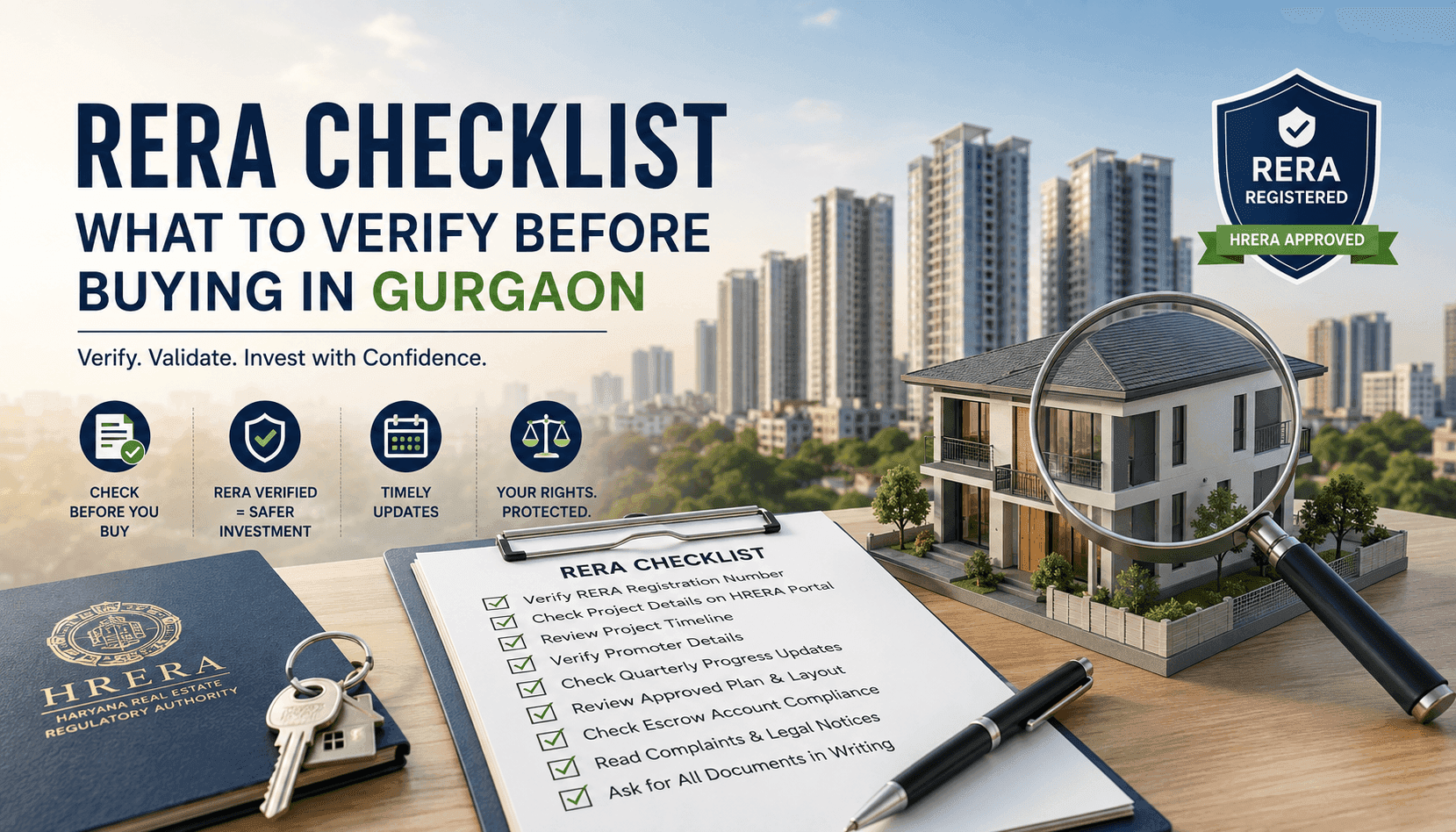
RERA Checklist: What to Verify Before Buying in Gurgaon
Real Better Team
August 3, 2026
A practical RERA checklist for Gurgaon homebuyers — what to check on the RERA portal, red flags, and documents to ask for before booking.
Every year, thousands of homebuyers in Gurgaon sign an allotment letter and pay a token amount before they've actually confirmed the one document that matters most: the project's RERA registration. It sounds like a formality. It isn't. RERA registration is the closest thing Indian real estate has to a safety net for buyers, and skipping the verification step is one of the most common — and most avoidable — mistakes people make when buying property in Gurgaon.
This guide walks through exactly what RERA registration means, what it does and doesn't protect you from, and a step-by-step checklist you can actually use before you pay anything to a builder or agent.
What Is RERA, and Why Does It Matter in Gurgaon Specifically?
RERA stands for the Real Estate (Regulation and Development) Act, a central law passed in 2016 that each state implements through its own regulatory authority. In Haryana — which includes Gurgaon — this authority is HRERA, the Haryana Real Estate Regulatory Authority.
Before RERA, real estate in India operated with very little structured oversight. Builders could market a project years before construction began, collect payments without any legal obligation to use that money on the specific project, delay possession indefinitely with no consequence, and change floor plans or amenities after buyers had already paid. Gurgaon, given how fast it grew as a real estate market from the early 2000s onward, saw its fair share of these problems — several projects from that era are still tied up in delays or litigation.
RERA changed the underlying structure. Registered projects are legally required to:
Register with HRERA before marketing or selling any unit
Disclose the sanctioned building plan, layout, and timelines publicly
Deposit 70% of the funds collected from buyers into a separate escrow account, which can only be used for construction and land costs of that specific project
Provide quarterly updates on construction progress
Compensate buyers for delays beyond the declared possession date, under specified conditions
None of this makes RERA registration a guarantee that a project will be delivered on time or built to a certain standard. It doesn't verify architectural quality, and it doesn't eliminate every kind of dispute. What it does is create a paper trail and a legal obligation — which matters enormously if something does go wrong later.
What RERA Registration Actually Protects You From
It's worth being precise about this, because a lot of buyers assume RERA is a blanket guarantee, and that assumption can lead to complacency elsewhere in the buying process.
RERA registration helps protect you from:
Builders indefinitely delaying possession without any recourse for buyers
Funds collected for your project being diverted to fund a different, unrelated project
Builders changing the sanctioned plan (unit sizes, amenities, tower count) without buyer consent
A complete lack of information about project status, since quarterly updates are mandatory
RERA registration does NOT protect you from:
Construction quality issues that fall short of what was promised verbally but aren't part of the legal specification
Disputes over resale properties, since RERA primarily governs the primary sale of new projects, not later resale transactions
Title disputes on the underlying land, which is a separate legal check entirely
Delays that fall within legally permitted extensions (force majeure clauses, for instance)
This is why RERA verification should be one part of your due diligence, not the entirety of it. Pair it with title verification, a site visit, and — for any high-value transaction — a lawyer's review of the specific agreement.
Step-by-Step RERA Verification Checklist
Here's the practical sequence to follow before you commit any money, even a token amount, to a project in Gurgaon.
Step 1: Ask for the RERA Registration Number Directly
Every piece of marketing material for a registered project — brochures, website listings, advertisements — is legally required to display the RERA registration number. If a sales representative or agent can't immediately produce this number, or gives you a vague answer like "it's in process," treat that as a serious red flag rather than a minor delay.
Write the number down exactly as given. RERA numbers typically follow a state-specific format (for Haryana, HRERA numbers usually begin with a project-specific code), and even small transcription errors will cause your portal search to fail, so double-check it.
Step 2: Cross-Check the Number on the HRERA Portal
The Haryana RERA authority maintains a public online portal where you can search registered projects by RERA number, project name, or promoter/builder name. This step is non-negotiable — never take a builder's word for a registration's validity without confirming it independently.
When you search, verify that:
The project name matches exactly what you've been shown in marketing material
The promoter (builder/developer) name matches
The registration status is "valid" or "active," not "lapsed," "revoked," or "under review"
The registered land area and sanctioned unit count are broadly consistent with what's being marketed to you
If any of these don't line up, ask the builder directly for a written explanation before proceeding — a genuine registered project should have no trouble producing consistent documentation.
Step 3: Check the Promised Possession Date Against the RERA Filing
This is one of the most valuable — and most overlooked — pieces of RERA data. The RERA filing includes a legally declared possession date. Compare this against whatever date the sales team is verbally quoting you.
It's common for sales teams to quote an optimistic date that's earlier than what's actually filed with RERA. The RERA-declared date is the one with legal weight; the verbal promise generally isn't. If there's a gap of more than a few months between what you're told and what's filed, ask why, and factor the RERA date — not the sales pitch — into your own planning.
Step 4: Review the Sanctioned Layout Plan
RERA filings include the sanctioned building plan and layout. This matters because Gurgaon has seen cases where developers market "future phases" of a project that are not yet registered, using the credibility of an already-registered earlier phase to sell units in a phase that hasn't cleared the same regulatory process.
Confirm specifically:
Which tower, floor, and unit you're being sold is part of the currently registered plan
That the amenities being marketed (clubhouse, specific green spaces, etc.) are actually part of the sanctioned layout, not aspirational additions
That any changes to the plan since registration have been formally updated with HRERA, not just communicated informally
Step 5: Check the HRERA Complaints and Orders Section
The HRERA portal also allows you to search for any complaints, orders, or penalties associated with a specific project or promoter. A single historical complaint doesn't necessarily disqualify a project — disputes happen — but a pattern of unresolved complaints, especially around possession delays or fund misuse, is a meaningful signal worth taking seriously.
Step 6: Request the RERA Certificate Directly, Not Just the Number
Beyond the registration number, ask for a copy of the actual RERA certificate. Reputable builders will provide this without hesitation. Reluctance to share the certificate itself — even when the number checks out on the portal — is worth probing further before you proceed.
Red Flags to Watch For
A few patterns come up repeatedly in complaints from Gurgaon homebuyers, and they're worth knowing in advance so you can spot them early rather than after you've already paid something.
"RERA registration is in process" as a reason to pay now. This is one of the most common pressure tactics. Under RERA rules, a project generally cannot be marketed or sold before registration is complete. If you're told to pay a token amount now to "lock in" pricing before registration clears, that's a significant risk — you have no legal protection at that stage.
A registration number that doesn't match on the portal search. Sometimes this is a genuine clerical error. More often, it means the number belongs to a different project or a different phase than the one being sold to you. Always resolve this discrepancy in writing before proceeding, not verbally.
Reluctance to let you independently search the portal. A legitimate project has nothing to hide here — a five-minute portal search is public information. If a sales team actively discourages you from checking independently ("just trust the certificate we've shown you"), treat that as a signal to slow down.
Marketing materials without a visible RERA number. Regulated marketing materials are required to display the number. Its absence, especially on formal brochures or website listings, suggests either an oversight in compliance or, more concerningly, that registration hasn't actually happened yet.
What If a Project Isn't RERA Registered?
Not every property transaction in Gurgaon requires RERA registration. There are legitimate exemptions:
Resale of already-completed units — RERA primarily governs the sale of new projects by a promoter/builder, not the private resale of an already-registered-and-completed unit between individual owners. In resale transactions, your due diligence shifts toward title verification, existing occupancy certificates, and the resale agreement itself.
Smaller developments below the size threshold — RERA registration requirements typically apply above a certain plot size or unit count threshold, which varies by state. Smaller developments may fall outside mandatory registration.
Projects that predate RERA and received all approvals before the Act came into force may have different compliance obligations.
If a builder or agent claims an exemption applies, don't accept a verbal explanation. Ask for the specific legal basis in writing, and if you're planning a significant purchase, have a property lawyer confirm whether the claimed exemption genuinely applies to your specific transaction.
Bringing It Together: A Pre-Booking Checklist
Before you pay any amount — including a token booking amount — for a project in Gurgaon, you should be able to check off each of the following:
RERA registration number obtained directly from the builder or listing
Number independently verified on the HRERA portal
Project name and promoter name match across marketing material and the portal listing
Registration status confirmed as active/valid, not lapsed or revoked
RERA-declared possession date compared against the verbally promised date
Specific tower/unit confirmed as part of the currently sanctioned and registered plan
HRERA complaints/orders section checked for the project and promoter
RERA certificate obtained directly, not just the registration number
If claiming exemption from RERA, the legal basis obtained in writing
This isn't a process that should take more than an hour or two, and a legitimate, well-run project will make it easy for you to complete every step. Treat any friction in this process — vague answers, discouraged independent verification, pressure to pay before documentation is confirmed — as valuable information about how the rest of the transaction is likely to go.
Where to Go From Here
RERA verification is one part of a broader due diligence process when buying property in Gurgaon. It should be paired with independent title verification, a physical site visit where possible, and — for any high-value purchase — a review by a property lawyer of the specific builder-buyer agreement, not just the marketing documentation. RealBetter's verification process checks available documentation, including RERA status where applicable, before a listing is published, but the HRERA portal check described above is something every buyer should also do independently before finalizing a purchase.
Internal Links
Frequently Asked Questions
Most new residential and commercial projects above a minimum size threshold require RERA registration in Haryana. Smaller developments and resale of already-completed units may fall outside this requirement — always confirm the specific exemption in writing if one is claimed rather than accepting a verbal explanation.
Search the registration number directly on the HRERA (Haryana RERA) portal and confirm the project name, developer, and registration status match what you've been told by the builder or agent.
RealBetter's verification process checks available documentation, including RERA status where applicable, before a listing is published. Always confirm current status directly with HRERA before booking, since registration status can change.
Under RERA, buyers can claim interest for delayed possession or seek a refund, depending on the specific terms of the allotment agreement. The exact remedy available depends on your project's specific RERA filing and agreement — consult the RERA order for that project and a legal advisor for your particular situation.
It's possible in cases of legitimate exemption (certain resale transactions, smaller developments, or pre-RERA projects), but you take on significantly more risk without the escrow, disclosure, and delay-compensation protections RERA registration provides. If considering an unregistered project, a lawyer's review becomes even more important than usual.
Search "HRERA" or "Haryana RERA official portal" to find the current government portal — always use the official government domain and avoid third-party sites claiming to offer the same lookup, since only the official portal reflects current, authoritative registration status.
Still have questions? Contact our team