Sohna Road vs Dwarka Expressway: Which Micro-Market Should You Choose?
Real Better Team
August 8, 2026
Two of the most frequently compared corridors when buyers and investors are evaluating Gurgaon are Sohna Road and Dwarka Expressway. Both offer a wide range of residential inventory, both have seen substantial development activity in recent years, and both regularly come up as "which one should I choose" questions from buyers weighing similar budgets against these two options.
They're not interchangeable, though. Each has a distinct character, growth trajectory, and set of tradeoffs. This guide compares them directly across the factors that actually matter for a buying decision — connectivity, pricing dynamics, inventory type, social infrastructure, lifestyle character, and growth outlook — so you can weigh them against your own priorities rather than a generic "which is better" verdict.
A Quick Orientation to Each Corridor
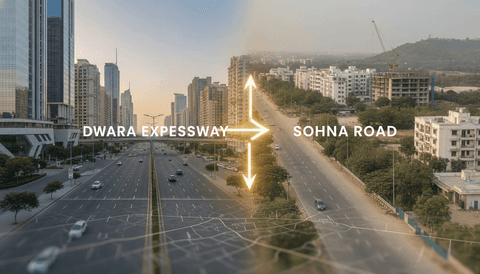
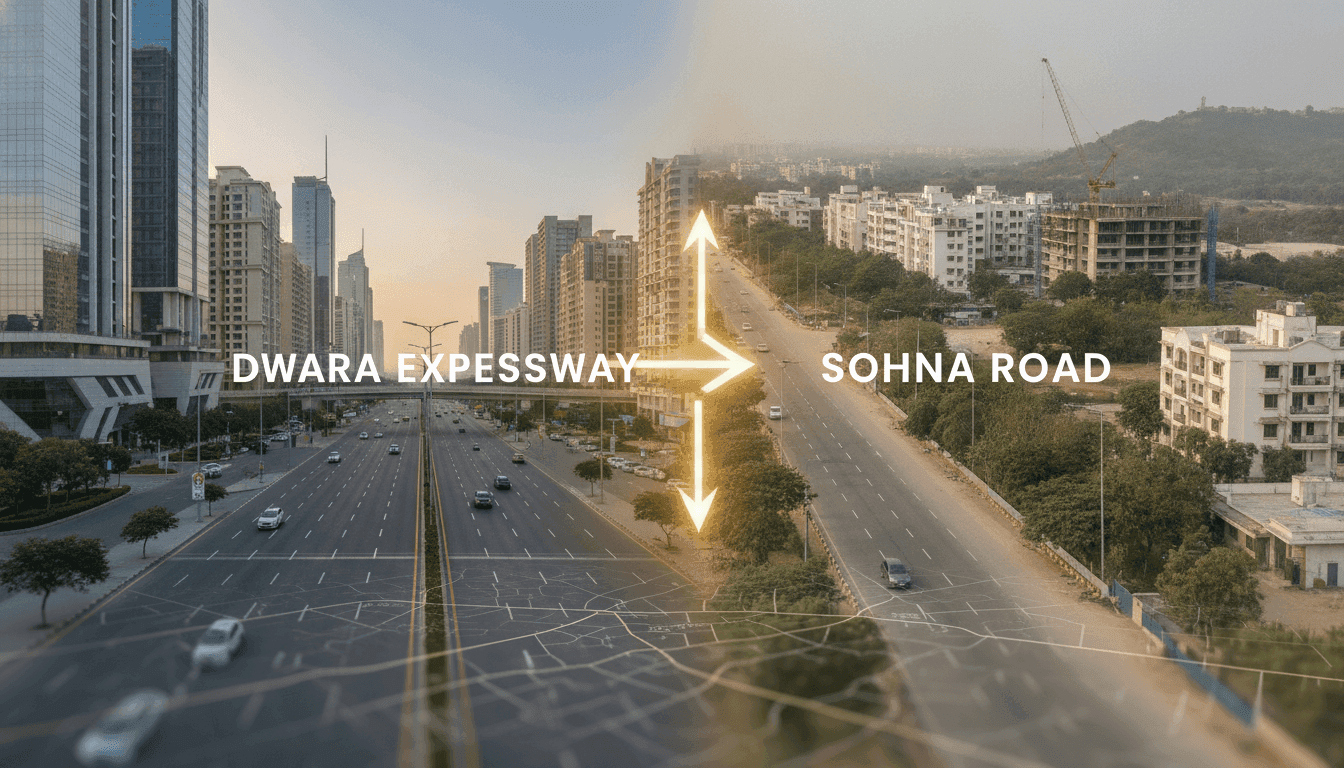
Sohna Road runs southward from central Gurgaon toward Sohna town, and has been a developing residential and commercial corridor for a longer period than Dwarka Expressway. It has a mix of established and newer residential projects, along with retail and commercial development that has matured over time, giving it a somewhat longer track record than some of Gurgaon's newest growth corridors. Because it has been developing for longer, Sohna Road today reflects several distinct waves of construction — older, more established pockets closer to central Gurgaon, and newer developments further along the corridor, each with somewhat different pricing and inventory characteristics.
Dwarka Expressway (also referred to as the Northern Peripheral Road in some official contexts) connects Gurgaon to Dwarka in Delhi and is one of the most actively developing corridors in the entire NCR region currently. It's anchored by several large integrated townships and has seen a significant volume of new residential launches in recent years, positioning it as one of Gurgaon's primary growth corridors going forward. Unlike Sohna Road's more layered development history, Dwarka Expressway's growth has been more concentrated and recent, meaning much of its current inventory reflects a more contemporary approach to master-planned, amenity-rich residential development.
Connectivity — A Closer Look
Sohna Road offers relatively direct connectivity to central Gurgaon and onward toward NH-48, making it reasonably convenient for daily commutes to established commercial hubs like Cyber City and Golf Course Road, though travel times can vary significantly with traffic conditions given the corridor's continued development and traffic volume. The corridor has also seen ongoing road-widening and infrastructure improvement efforts over time, which has generally improved connectivity as the corridor has matured, though as with most rapidly developing areas, road capacity and traffic volume growth don't always move in perfect sync.
Dwarka Expressway, once fully complete, is designed to offer a faster, more direct connection between Gurgaon and Delhi, specifically toward Dwarka and onward to the airport corridor. This is one of the core reasons the corridor has attracted such significant development interest — the connectivity proposition, once fully realized, is compelling for both Gurgaon-based commuters and those who frequently travel toward Delhi or the airport. The expressway is also positioned to eventually offer improved connectivity to other parts of Gurgaon and the broader NCR road network as the full corridor is completed.
It's worth noting that both corridors' connectivity advantages are tied partly to infrastructure that has been developed in phases, so the actual day-to-day commute experience can differ from the eventual, fully-realized connectivity vision. If commute time to a specific workplace is a major factor in your decision, it's worth testing the actual current commute at relevant times of day rather than relying solely on stated distances or planned infrastructure timelines. This is particularly important for Dwarka Expressway, where some sections of the planned infrastructure have historically taken longer to complete than initially projected — a pattern common to large infrastructure projects generally, not specific to this corridor, but worth factoring into your own timeline expectations regardless.
For public transit specifically, it's worth checking current bus and any upcoming metro connectivity plans for both corridors directly, since these details evolve and can meaningfully affect day-to-day convenience beyond private vehicle commute times alone.
Pricing Dynamics
Sohna Road is generally positioned as one of the more value-for-money corridors in Gurgaon, offering a broader range of pricing across both budget and premium segments, given its longer development history and wider mix of project vintages. Because the corridor spans a considerable distance, pricing can vary meaningfully depending on proximity to central Gurgaon versus sections further along the corridor toward Sohna town — sections closer to established commercial hubs generally command a premium over those further out.
Dwarka Expressway has seen substantial price appreciation in recent years as development has accelerated, though pricing still varies considerably depending on the specific sector and project — proximity to key infrastructure nodes within the broader corridor can create meaningful pricing differences even within Dwarka Expressway itself. Because much of the corridor's development is more recent and more heavily weighted toward larger, master-planned townships, pricing here often reflects a different value proposition than Sohna Road — buyers are frequently paying, in part, for newer construction, more extensive on-site amenities, and exposure to the corridor's growth narrative, rather than purely for established connectivity and social infrastructure that already exists today.
Neither corridor should be thought of as uniformly priced — within each, pricing varies by specific sector, project vintage, builder reputation, and proximity to key connectivity or amenity nodes. When comparing the two corridors for your specific budget, it's more useful to compare specific projects or sectors against each other than to compare the corridors as monolithic categories.
Inventory and Property Types
Sohna Road offers a genuinely broad mix of inventory — apartments across a range of budgets, a meaningful supply of builder floors, and some plotted development options, reflecting its longer development history and the variety of builders who have developed projects along the corridor over time. This diversity means buyers with different priorities — those wanting a builder floor's privacy, those wanting an apartment's amenities, those interested in a plot for eventual self-construction — can generally find relevant options within the Sohna Road corridor without needing to compromise on property type.
Dwarka Expressway inventory skews more heavily toward larger integrated township developments with apartments as the dominant product type, though builder floor and other inventory types are increasingly present as the corridor continues to mature and diversify. The township-style developments common along this corridor often bundle in more extensive on-site amenities — larger clubhouses, more extensive landscaping, sometimes retail components within the township itself — reflecting the more contemporary master-planning approach many newer projects here have taken.
If you're specifically looking for a builder floor rather than an apartment, Sohna Road currently offers a somewhat wider and more established selection, though this gap has been narrowing as more diverse development reaches Dwarka Expressway.
Social Infrastructure — Schools, Hospitals, Retail
This is one of the areas where the two corridors' different development timelines show up most clearly.
Sohna Road, having developed over a longer period, generally has more established social infrastructure already operational — a wider existing base of schools, hospitals, and retail options that have had time to develop alongside the residential growth. For families specifically, this means a broader set of already-operating school options across different curricula and price points, along with established healthcare facilities that have built a track record within the local community.
Dwarka Expressway, as a faster-growing and newer corridor, is still in the process of building out this social infrastructure alongside its residential development. Many large townships plan for schools, hospitals, and retail within their master plans, but the actual operational timeline for these amenities can lag behind residential possession — worth specifically checking for any project you're considering, rather than assuming planned amenities are already operational. In the interim, residents along parts of Dwarka Expressway sometimes rely on facilities in adjacent, more established parts of Gurgaon or Delhi, which is worth factoring into your day-to-day convenience expectations if you're considering this corridor today rather than a few years from now.
If having established schools, hospitals, and retail options readily available today, rather than in a planned future timeline, is a priority — particularly relevant for families with school-age children — this is a meaningful point in Sohna Road's favor at the current stage of each corridor's development.
Lifestyle and Community Character
Beyond the more measurable factors of connectivity, pricing, and social infrastructure, the two corridors also offer somewhat different day-to-day living experiences worth considering.
Sohna Road, given its longer development history, generally has a more established sense of neighborhood character — longer-tenured residents, more mature landscaping and streetscape, and a broader mix of independent local businesses that have grown up alongside the residential development over time. This can appeal to buyers who value a sense of established community and don't mind a corridor that isn't uniformly new construction.
Dwarka Expressway, being earlier in its development curve, currently has more of a "new build" character — larger, more uniformly master-planned developments, often with extensive on-site amenities designed to be somewhat self-contained, particularly while surrounding social infrastructure is still developing. This can appeal to buyers who specifically value newer construction, extensive on-site amenities, and are comfortable with a still-evolving surrounding neighborhood character, viewing this as part of the appeal of getting in early on a corridor's growth story.
Neither character is objectively better — it's genuinely a matter of personal preference, and worth considering alongside the more measurable factors above.
Growth Potential and Investment Outlook
This is where the comparison genuinely depends on your goals as either a homebuyer or an investor.
Sohna Road, being a more mature corridor, likely has somewhat more moderate near-term appreciation potential compared to Dwarka Expressway, simply because a larger share of its development trajectory has already played out. That said, "more mature" also generally means more predictable — social infrastructure gaps are smaller, and the corridor's character is already largely established rather than still being defined.
Dwarka Expressway is generally viewed as offering stronger appreciation potential specifically because it's earlier in its development curve, with substantial infrastructure and residential development still to come. This comes paired with more execution risk — appreciation expectations are tied to infrastructure and amenity development actually completing on a reasonable timeline, which is a genuine variable rather than a certainty.
For an investor specifically prioritizing appreciation and willing to accept more timeline uncertainty, Dwarka Expressway is often the more actively discussed corridor. For a homebuyer prioritizing move-in-ready social infrastructure and a more predictable living experience today, Sohna Road's longer track record is often the more comfortable choice.
It's worth noting these positions aren't permanently fixed — as Dwarka Expressway continues to mature over the coming years, its profile is likely to shift progressively closer to where Sohna Road (or GCER) sits today, at least in relative terms, though the specific timeline for this maturation depends heavily on infrastructure and development execution that's genuinely difficult to predict with precision from today's vantage point.
A Side-by-Side Comparison
Factor | Sohna Road | Dwarka Expressway |
|---|---|---|
Development stage | More mature, longer track record | Rapidly developing, earlier stage |
Connectivity | Direct route to central Gurgaon/NH-48 | Fast Gurgaon-Delhi link, still maturing |
Pricing | Broad range, generally value-oriented | Wide range, has seen strong recent appreciation |
Inventory mix | Apartments, builder floors, some plots | Predominantly large township apartments |
Social infrastructure | More established today | Still developing alongside residential growth |
Neighborhood character | Established, mixed vintage | Newer, more master-planned, self-contained |
Appreciation outlook | More moderate, more predictable | Higher potential, more execution risk |
Best suited for | Buyers prioritizing move-in-ready infrastructure | Investors and buyers comfortable with growth-stage risk |
Questions to Ask Yourself Before Choosing
How soon do you need established social infrastructure to be operational? If you have school-age children or specific healthcare needs and want existing options rather than planned future ones, this weighs toward Sohna Road at the current stage of development.
What's your investment horizon, if buying partly or fully as an investment? A longer horizon can better absorb the execution timeline risk that comes with Dwarka Expressway's growth-stage profile; a shorter horizon may favor Sohna Road's more established, predictable trajectory.
What property type are you specifically looking for? If a builder floor is a firm preference rather than an apartment, Sohna Road currently offers a wider established selection.
How does your daily commute actually look from each corridor? Test real commute times to your specific workplace or regular destinations at relevant times of day, rather than relying on general connectivity claims for either corridor.
What's your risk tolerance around infrastructure timelines? If planned infrastructure — road connectivity, metro extensions, social amenities — slipping by a year or two would be a significant problem for your plans, weigh that specifically against Dwarka Expressway's continued dependency on infrastructure still being completed.
Do you prefer an established neighborhood character or a newer, more self-contained township environment? This is a genuinely personal preference that's easy to overlook amid more measurable factors like price and connectivity, but it meaningfully affects day-to-day satisfaction with your eventual choice.
How important are on-site amenities within your specific development, versus broader neighborhood amenities? Newer Dwarka Expressway townships often bundle in more extensive amenities within the project itself, which can partially offset the surrounding area's still-developing social infrastructure, depending on the specific project.
It Doesn't Have to Be Either-Or
Some buyers, particularly investors building a broader portfolio, choose to hold positions in both corridors specifically to balance the more predictable, established profile of Sohna Road against the higher-growth-potential profile of Dwarka Expressway. This isn't necessary or right for everyone, but it's worth knowing this is a common approach rather than assuming the decision must be exclusively one or the other.
For homebuyers rather than pure investors, this dual approach is less common given the practical constraints of actually living in one place, but the underlying logic still applies conceptually — if you're genuinely torn between the two, it can be worth explicitly weighing which specific tradeoffs matter most to your actual day-to-day life, rather than trying to find a corridor that wins on every single dimension, since neither currently does.
What to Verify Before Committing to Either Corridor
Regardless of which corridor you lean toward, a few verification steps apply equally to both:
Confirm RERA registration status for any specific project under consideration — see our dedicated RERA checklist for the complete verification process, since this applies identically regardless of which micro-market you're evaluating.
Independently verify the current, actual status of any planned infrastructure or amenities the project or corridor's appeal is tied to, rather than relying solely on marketing materials or sales team representations — this is particularly important for Dwarka Expressway specifically, given how much of its investment case depends on infrastructure that's still being completed.
Test actual commute times and visit the neighborhood at different times of day, ideally including both weekday and weekend visits, to get a genuine sense of traffic patterns, noise levels, and the surrounding neighborhood's actual current state, rather than relying entirely on a single showroom visit or marketing presentation.
Getting Specific Rather Than General
Ultimately, comparing these two corridors at a macro level is a useful starting point, but the actual decision should come down to specific projects, specific sectors, and specific current pricing and inventory — general corridor-level comparisons like this one are meant to narrow your search, not replace direct evaluation of the specific listings you're actually considering.
Internal Links
Frequently Asked Questions
It depends on your risk tolerance and horizon. Dwarka Expressway generally offers higher appreciation potential paired with more execution risk tied to ongoing infrastructure development, while Sohna Road offers a more established, predictable profile with more moderate near-term appreciation potential.
Sohna Road, having developed over a longer period, generally has more established social infrastructure operational today. Dwarka Expressway's social infrastructure is still developing alongside its residential growth, with much of it planned within township master plans rather than currently operational.
It can be, particularly for buyers comfortable with a still-developing corridor and interested in newer, larger integrated township developments. It's worth specifically verifying the current status of planned social infrastructure and connectivity projects relevant to your timeline.
Yes — Sohna Road currently offers one of the wider and more established builder floor selections among Gurgaon's growth corridors, alongside a broad mix of apartment inventory.
This varies significantly by your specific destination and time of travel. Sohna Road offers relatively direct access to central Gurgaon, while Dwarka Expressway is designed for faster Gurgaon-Delhi connectivity, though both corridors' full connectivity potential depends partly on infrastructure that has developed in phases — test actual commute times for your specific situation rather than relying solely on general claims.
Yes, some investors specifically diversify across both to balance Sohna Road's more predictable, established profile against Dwarka Expressway's higher-growth, higher-risk profile, though this approach depends on your specific investment goals and available capital.
Sohna Road generally has a more established neighborhood character given its longer development history, while Dwarka Expressway currently has more of a newer, master-planned township character, with surrounding social infrastructure still developing.
Still have questions? Contact our team